


THERE SHOULD BE NO INDIFFERENCE IN THE FIGHT AGAINST CORRUPTION
"Corruption is the root from which flows, at all times and under all temptations, contempt for all laws."
Thomas Hobbes
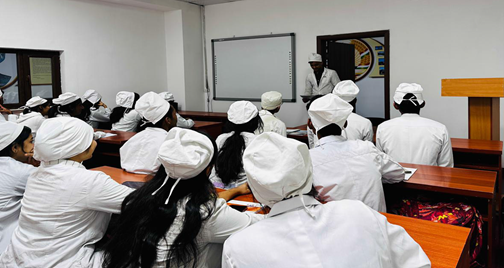
From December 19 to 20, 2025, at the department of propaedeutics of children diseases of the SEI "Avicenna Tajik State Medical University", under the supervision of assistant Ashurova A.K. open lessons on the topic: "We will eradicate corruption" were held with the participation of the department staff and 3rd course bachelor students of 7 and 15 groups.
Corruption occurs at various levels of government and in virtually all sectors of the state. This topic is currently relevant, as it is one of the most important national issues. So, what is corruption and why does it concern each of us? Corruption is defined as the abuse of official position, the giving or receiving of a bribe, the abuse of authority, commercial bribery, or other illegal use by an individual of their official position contrary to the legitimate interests of society and the state for the purpose of obtaining a benefit in the form of money, valuables, other property or services of a property nature, or other property rights for oneself or for third parties, or the illegal provision of such a benefit to the said individual by other individuals, as well as the commission of such acts on behalf of or in the interests of a legal entity.
Today, no one in the world is indifferent to the phenomenon known as "corruption." Corruption remains one of the key obstacles to economic development and social progress. The problem affects various levels of government and spheres of public life worldwide. According to national studies, citizens encounter corrupt practices when accessing basic public services, which undermines trust in government institutions.
Key facts include declining investment attractiveness, inefficient distribution of budget funds, obstacles to small business development, and weakening social justice.
The main areas of corruption - are government services (obtaining permits, licenses, registering a real estate business), education (admission to universities, obtaining diplomas, academic performance), healthcare (access to quality medical care and medicines).
Corruption creates a system where success depends not on ability and hard work, but on connections and financial resources. This deepens social stratification and deprives talented youth of opportunities. When citizens see impunity for corrupt officials and the injustice of institutions, law enforcement agencies, and the judicial system, their trust is lost. The spread of corruption normalizes unethical behavior in society and erodes traditional values of honesty and fairness, particularly affecting the younger generation.
Combating corruption is a complex undertaking, as it permeates virtually every sphere of activity. Despite this, measures aimed at eradicating it is being taken. Currently, corruption poses a significant threat to the state and society as a whole. Of course, these measures are insufficient, and corruption continues to permeate all aspects of citizens' lives. Specific measures to eliminate corruption should include: increasing the salaries of civil servants; amending legislation; banning those caught accepting a bribe from holding civil service positions; and strict penalties for corruption offenses. Anti-corruption policy should be a comprehensive set of measures and procedures, the combined application of which will produce the expected positive results.
Legal basis for anti-corruption policy
Tajikistan has the necessary legislative instruments to combat corruption:
-Law "On the Fight against Corruption" (2005).
- Criminal Code with articles on corruption crimes.
-Law “On Civil Service”.
- National Anti-Corruption Strategy
The Republic of Tajikistan has adopted the Law "On Combating Corruption,"
which aims to protect human and civil rights and freedoms, the interests of society, and ensure national security and the moral functioning of government bodies. It also promotes integrity and impartiality in public service, establishes the
organizational and legal framework for preventing, identifying, exposing, and eliminating the consequences of corruption-related offenses, prosecuting individuals, and defines the types of corruption related offenses and penalties for committing them.
Department of propaedeutics of children diseases