

MEETING OF THE STUDENT SCIENTIFIC SOCIETY AT THE DEPARTMENT OF PROPAEDEUTICS OF CHILDREN'S DISEASES
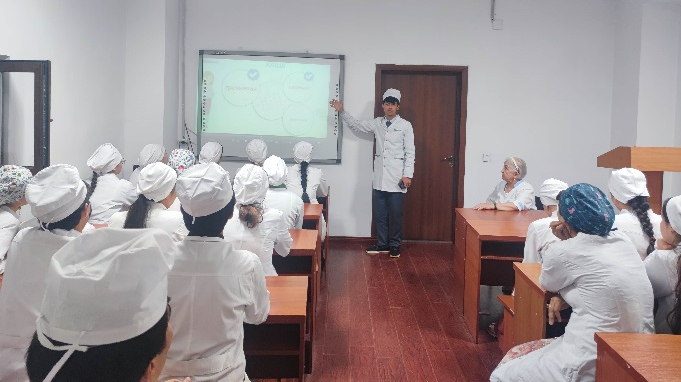
On May 23, 2025, a regular meeting of the Student Scientific Society was held at the Department of Propaedeutics of Children’s Diseases of the SEI “Avicenna Tajik State Medical University” under the guidance of the department’s associate professor, Candidate of Medical Sciences G.A. Rakhmanova, and assistant A.A. Giyosov.
The topic of the session was “Nutrition of children over 1 year of age.” Third-year students of group 66 of the Faculty of Medicine, M. Hakimov and M. Niyazova, prepared and presented a detailed presentation on this topic. They emphasized that appropriate feeding during the first year of life significantly facilitates the organization of nutrition in subsequent age periods.
When planning the diet of children over one year of age, it is necessary to consider the physiological characteristics and nature of metabolic processes at this stage. In particular, during the second year of life, the chewing apparatus develops, allowing the inclusion of foods that require chewing. Moreover, this age is marked by the further development of enzymatic functions of the digestive glands, the differentiation of taste perceptions, and improvement in digestion and nutrient absorption processes. The variety of meals expands, and the consistency of food becomes more solid and diverse.
The protein requirement for children aged 1 to 3 years should be 3.5–4 g/kg per day, and for those aged 12 to 15 years, 2–2.5 g/kg per day. A deficiency of protein in the diet can lead to delayed physical and mental development, weakened immunity, and impaired erythropoiesis. Children need not only an optimal amount but also high-quality protein; therefore, proteins of both animal and plant origin with different amino acid compositions should be included in their diet.
The presentation was accompanied by slides and a video highlighting the features of nutrition for children over 1 year old, which plays a key role in forming a healthy generation.
At the end of the presentation, students asked questions on various aspects, including the preparation of specific dishes. A discussion followed on the harmful effects of fast food and carbonated drinks and their impact on children’s mental, physical, and neuropsychological development, emphasizing the inappropriateness of their consumption during childhood.
Department of propaedeutics of children’s diseases