
DOUBTS THAT THEORY DOES NOT RESOLVE, PRACTICE WILL RESOLVE
"Tell me and I will forget, show me and I will not be able to remember, involve me in participation and I will understand."
Indian Proverb
At present, a large list of requirements is imposed on a doctor as a specialist. The emergence of complex medical equipment and technologies, changes in moral and legal conditions in the doctor-patient relationship have become one of the reasons for the modernization of the system of training medical personnel. The basis of medical education is clinical training. Modern medical phantoms, simulators and simulators equipped with electronic equipment make it possible to simulate not only simple manual actions, but also to imitate symptoms and situations necessary for practical training at different stages of doctors' education. changes in the patient's condition after therapeutic measures. The well-equipped Simulation Training Center of SEI «ATSMU», which has been operating since August 30, 2012, allows you to improve the quality of students' mastery of the educational material. This training meets the safety requirements for the admission of students to participate in the provision of medical care and significantly reduces the degree of risk of their practical activities. It is important not only for students to master practical skills and abilities, but also for the opportunity to repeat the study, bringing the technique to perfection. A properly organized educational process, which takes into account the individual characteristics of students, allows you to form and develop clinical thinking, professional skills and abilities when performing diagnostic and surgical manipulations. All this makes it possible to minimize patient complaints associated with the insufficient level of the doctor's practical skills in performing medical manipulations - both diagnostic and therapeutic. The solution to the problem is properly organized practical and lecture classes, work in the simulation center.
Medical education is impossible without training in practical skills and abilities that should be applied in real life and professional conditions. Mastering practical actions cannot be learned with only a theoretical basic basis for the performance of certain medical procedures, practice-oriented training is required. Simultaneously with theoretical knowledge, practical skills are also mastered, when the person performing a practical action understands "right" and "wrong". With the repeated repetition of actions by students, skills turn into skills, as a result of which actions are brought to automatism. It is in this interaction - "knowledge - skills - skills" that a competent doctor is formed.
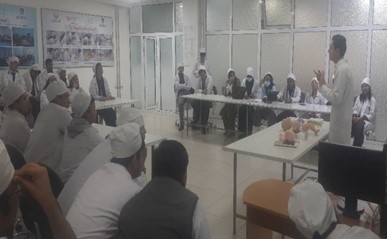
From November 21 to November 27, 2025, on the basis of the Center for Simulation Training SEI «ATSMU» a series of practical classes was held for students of the 2nd and 3rd years of undergraduate studies in the disciplines "Propaedeutics of children diseases" and "Clinical (communication) skills". The classes were aimed at practicing key practical skills.
Students worked out three main areas of training.
1. Auscultation of the heart in children. As part of the lesson, students:
- studied the main points of auscultation in children of different age groups;
- got acquainted with physiological and pathological tones and heart murmurs;
- We worked with simulation dummies equipped with an audio system that simulates real clinical sounds.
The assistants of the department demonstrated the technique of conducting the research methodology, after which the students independently performed auscultation under the supervision of a mentor.
2. Resuscitation of the newborn (according to the NRP protocol). A practical development of the primary resuscitation algorithm was carried out:
- assessment of the condition of the newborn;
- ensuring the patency of the airway;
- bag and mask ventilation;
- indirect heart massage.
Classes were conducted on specialized neonatal mannequins to control the correctness of compressions and the effectiveness of ventilation. Students worked in mini-groups, which ensured high involvement and quality of mastering the material.
3. Injection techniques (intravenous, intramuscular, subcutaneous). Students have mastered:
- intravenous injections and peripheral catheterization;
- intramuscular injections into the thigh and deltoid muscle;
- subcutaneous injections in compliance with all the rules of asepsis and antiseptics.
The practice was carried out on modern anatomical models that allow you to train the technique of inserting the needle, the correct choice of the injection site and the depth of injection of the drug.
Results of the cycle of classes. According to the results of the workshop, it was noted:
- confident performance by students of the basic skills provided by the program;
- Improved clinical readiness;
- activity and high interest of students in simulation technologies.
The classes have become an important part of the educational process and allowed students to gain valuable experience in a safe and controlled environment. The Simulation Training Center of SEI «ATSMU» continues to actively develop practice-oriented learning, providing students with access to modern medical training technologies.
The staff of the Department of propaedeutics of children diseases express special gratitude to the director of the STC, candidate of medical sciences, associate professor Usmonov J.N. for the good organization and assistance in conducting practical classes in the center.
Department of propaedeutics of children diseases