

CONDUCTING AN OPEN LESSON DEDICATED TO THE HOLIDAY OF NAVRUZ – A SYMBOL OF UNITY AND REBIRTH AT THE DEPARTMENT OF PROPAEDEUTICS OF CHILDREN'S DISEASES
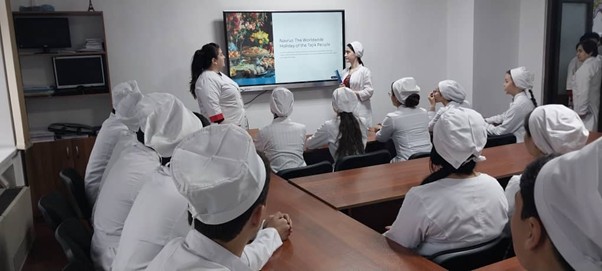
On March 18, 2026, assistant of the department F. M. Murodova held an open lesson at the department of propaedeutics of children's diseases dedicated to one of the most ancient and significant holidays - Navruz. As part of the lesson, 3rd student Gulomova M., group 46 of the medical faculty, prepared a presentation in which she explored the historical significance of the holiday, its traditions, and cultural characteristics.
Nowruz, which translates as "new day," symbolizes the arrival of spring, the renewal of nature, and the beginning of a new life cycle. The holiday has a history of over 6000 years. Nowruz is linked to the ancient culture of the peoples of the East, including the traditions of Zoroastrianism, which placed special emphasis on light, purity, and the struggle between good and evil.
Nowruz is celebrated on the vernal equinox, March 21st, when day and night become equal. This imbues the holiday with profound symbolism: balance is perceived as the ideal state of nature and humanity. Since ancient times, it has been said that this day marks the beginning of a new year according to the natural cycle, so Nowruz is considered the starting point of a new life.
Particular importance is attached to the idea of purification. People tidy their homes in advance, get rid of unnecessary things, forgive offenses, and strive to welcome the holiday with pure thoughts. This custom reflects an important philosophy: renewal should occur not only externally but also internally. Traditional dishes, each with a symbolic meaning, are an important part of the holiday. For example, sumanak, made from sprouted wheat, symbolizes life, patience, and prosperity. The cooking process is a collective and unifying act, accompanied by songs and good wishes.
Today, Nowruz remains relevant and meaningful, uniting peoples and cultures. It reminds us of the need to live in harmony with nature, to value peace, kindness, and mutual understanding, and to maintain a connection with our historical heritage.
Department of propaedeutics of children's diseases